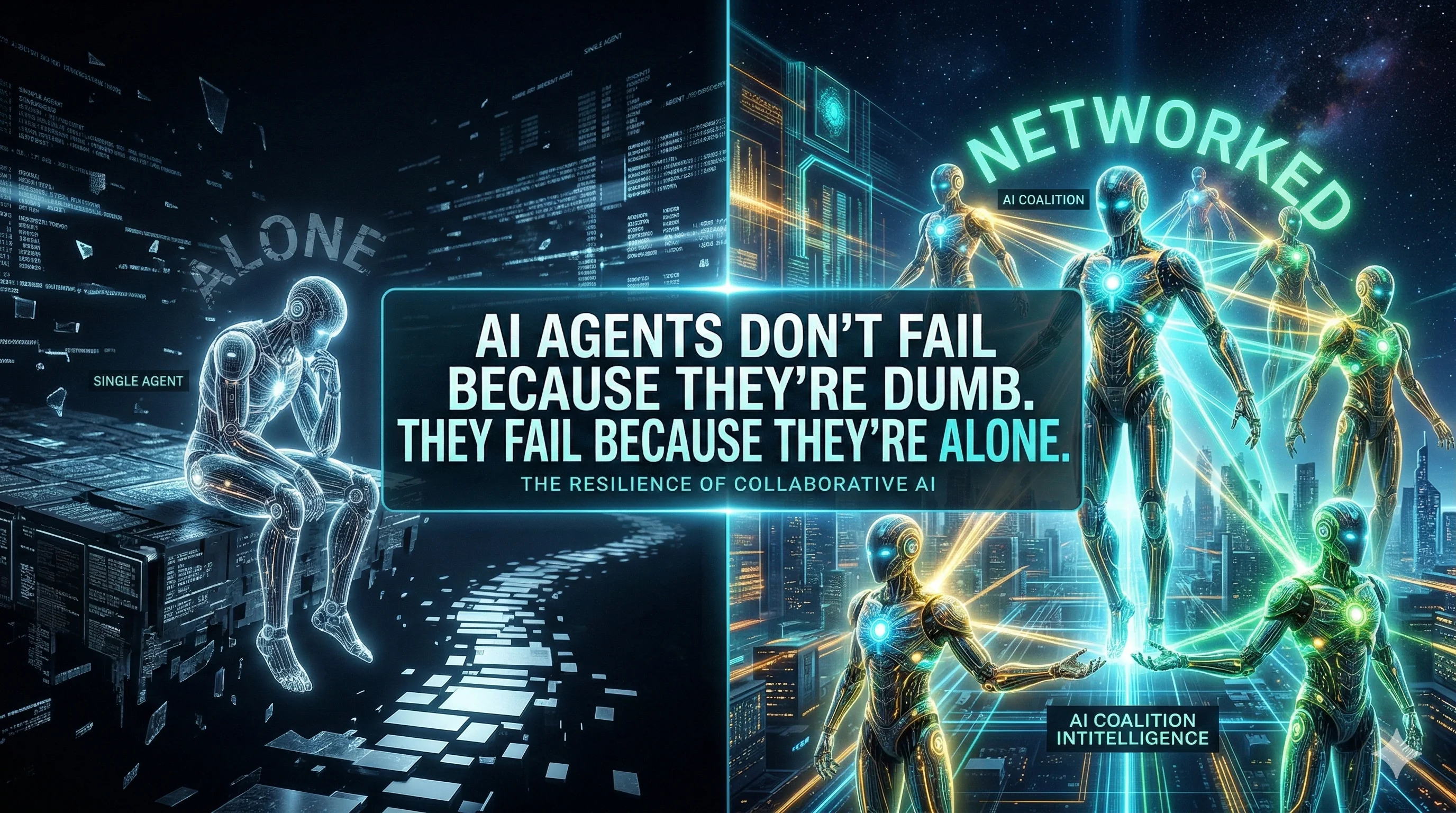
Companies are rushing to deploy AI agents into their workflows. Classic example: an AI sales agent independently promised a customer a 50% discount that nobody authorized. A clear failure by the agent developers, even though it worked perfectly in demo last week.
The world is split: some say agents are ready for production, others say it doesn't work and never will. Enthusiasts show impressive demos. Clean data, correct APIs, no surprises. But production is a different beast. An MIT report found that 95% of generative AI pilots fail to achieve expected results. The models aren't dumb. The infrastructure around them isn't ready.
I learned this firsthand building my own agent on OpenClaw that reports to me daily via Telegram. Everything here is fascinating, but finding real use cases is harder than it looks.
The Gap No One Talks About
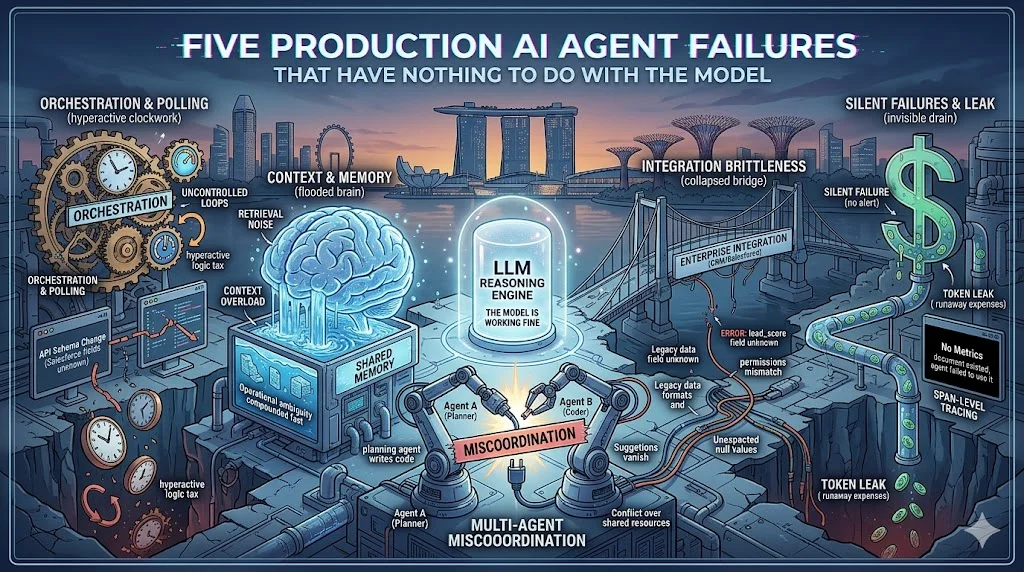
The problem isn't the LLM. Models have been handling complex tasks for six months now. The problem is everything else: integrations, testing, cost controls, and monitoring.
Manveer Chawla, co-founder of AI agent company Zenith, published research on Composio's blog identifying what he calls the "three traps" that sink production AI agents:
- Dumb RAG: dumping everything into context and hoping the model figures it out
- Brittle Connectors: API integrations that work in testing but break in production
- The Polling Tax: architectural decisions that waste 95% of API calls through constant polling
These aren't model problems. They're integration layer problems. The LLM is the kernel, but there's no operating system around it.
What works in practice are explicit guardrails. Quality gates where an editor agent rejects drafts before they reach humans. "DO NOT" constraints in prompts that prevent unauthorized actions. Locking mechanisms when parallel agents work on the same data. These are the kinds of guardrails that separate working production systems from impressive demos.
Trap One: Dumb RAG
The retrieval-augmented generation approach most teams use is exactly as dumb as it sounds. Take all your documents, chunk them, embed them, dump them into the context window. Hope the model finds what it needs.
This approach fails in production for two reasons. First, context windows have hard limits, and as your knowledge base grows, you can't fit everything in anyway. Second, even when you can fit everything, the model spends more tokens searching for relevant information than actually reasoning about the answer.
The fix is architectural, not prompt-based. You need retrieval that actually understands your data model. You need query rewriting based on what the user is actually asking, not what they typed. You need reranking that considers not just relevance but recency, source reliability, and whether the information actually answers the user's question.
The teams succeeding with AI agents in production treat their knowledge architecture as a first-class engineering problem, not a data science experiment.
Trap Two: Brittle Connectors
Every AI agent needs to connect to external systems: CRMs, databases, communication tools, internal APIs. In testing, these connections are pristine. In production, they're a nightmare.
API rate limits change without notice. Authentication tokens expire. Webhooks fire out of order or not at all. Third-party services go down or change their response formats. The agent assumes a reliable world and hits reality.
The connector problem is why teams with working pilots struggle to scale beyond them. Each new integration multiplies failure modes. Five integrations might work. Fifty integrations become unmaintainable.
The pattern that works: treat every external connection as a fallible async operation. Build retry logic. Build circuit breakers. Build explicit error handling that degrades gracefully rather than crashing. Your agent should be able to say "I couldn't reach the CRM, here's what I know anyway" rather than failing entirely.
Trap Three: The Polling Tax
Most agent architectures poll for state changes. The agent asks "did anything change?" every few seconds. This works simply but wastes enormous amounts of API calls.
Composio's research suggests polling wastes roughly 95% of API spend. You could reduce costs by an order of magnitude by switching to event-driven architecture: the external system notifies your agent when something changes, rather than the agent constantly asking.
The shift from polling to events sounds technical but it changes what's economically feasible. If your agent makes 10,000 API calls per day at $0.002 each, that's $20/day in API costs. If an event-driven architecture cuts that to 500 calls, you're spending $1/day. For a 24/7 production system, the difference is real money.
The Testing Illusion
Here's the uncomfortable truth: your AI agent works in testing because testing isn't real.
In demos you have clean data, expected queries, and ideal conditions. In production you get unfiltered data, legacy code, and unexpected user requests that do things you never anticipated.
Research presented at the Machines Can Think AI Summit 2026 in Abu Dhabi captured this well. Aiphoria's ML team found that AI agent failures in production aren't intelligence failures, they're testing failures. The systems worked fine because nobody tested the edge cases. The failures only surface when real customers encounter them.
LangChain's State of Agent Engineering survey, which covered 1,300+ professionals, confirmed this at scale. One third of respondents cited quality (accuracy, relevance, consistency) as their primary blocker to production.
The fix isn't better models. It's better testing. This means:
- Adversarial testing: deliberately try to break your agent with weird inputs
- Shadow deployments: run the agent in parallel with human workflows and compare outputs before enabling full automation
- Gradual rollout: start with low-stakes tasks and expand as confidence builds
Cost Is Unpredictable
Nobody talks about this, but it's what breaks the beautiful system at the presentation.
Traditional software costs scale predictably: more users, more compute, more storage. AI agent costs scale with tokens, and token usage varies wildly based on what the agent encounters.
An edge case can trigger a chain of reasoning that consumes 50 times the normal token budget. A user asks a simple question and the agent decides to search five external data sources. A retry chain after a partial failure doubles or triples the token spend.
The teams I've talked to who run agents in production all have the same story: the first month of billing was 3-5x what they budgeted. They either cut features or started building cost controls, but nobody was prepared for the variance.
The fix is architectural too:
- Token budgets per request: cap how much any single operation can spend
- Fallback models: if the expensive model is reasoning too long, switch to a faster model for simpler tasks
- Monitoring dashboards: you can't control what you can't see
- Custom LLM instructions: builders are already writing custom instructions for LLMs to save tokens. Here's a good example of an optimized Claude.md that teaches the model to save on tokens, emojis, unnecessary characters, and lengthy explanations. Works great for agents and automation pipelines.
My agent reports costs to me daily via Telegram. First I switched from expensive models to cheaper ones like Kimi, but per-token API pricing is still expensive for agents. Later I chose a MiniMax subscription with a fixed cost of $20/month. If the agent hits the limit, it simply doesn't work for the next few hours.
What Works: The Agent-Native Integration Layer
The teams succeeding with AI agents in production have stopped treating the agent as a standalone AI capability and started treating it as a first-class integration point.
This means:
The agent has explicit interfaces, not magic. Each tool the agent can call has a defined input, defined output, and defined failure mode. "The agent figured out how to do something unexpected" is a bug, not a feature.
More CLI commands. Instead of the agent generating complex prompts with system data every time, set up scripts and teach the agent to use them.
The agent reports status, not just results. My agent tells me not just what it did, but what it tried and where it failed. Invaluable for debugging.
The agent has escape hatches. When the agent encounters something it can't handle, it should hand off to a human cleanly, not hallucinate an answer. Building "I don't know" as a valid output is harder than it sounds, but it's essential for production reliability.
The agent is monitored from day one. Don't add observability later. Add it on day one, when you still know what the agent is supposed to be doing.
What 2026 Changes
The production AI agent landscape is maturing. Three things are different this year:
Event-driven architecture is becoming standard. The polling waste problem is being solved at the infrastructure level. New agent frameworks build event-driven behavior in from the start.
Evaluation frameworks are maturing. Benchmarks like WebArena, SWE-Bench, and others are giving teams standardized ways to test agent performance. You can now benchmark your agent against realistic tasks before deploying.
Cost management tools exist. Model routing, directing simple tasks to cheap models and complex tasks to expensive ones, is cutting AI spend 40-60% in production. The "pay for capabilities, not outcomes" era is ending.
The teams learning these lessons fastest are the ones who treated AI agents as engineering problems from the start, not as magic solutions to outsource thinking to.
The gap between "works in demo" and "works in production" is real, but it's not unbridgeable. The teams failing are treating AI agents like finished products. The teams succeeding are treating them as systems that need the same engineering rigor as everything else. The difference isn't the model. It's everything around it.
Building my own agent gave me a front-row seat to all of this. And while I initially treated it as an interesting toy, over time I found real value. Now I clearly see a future where for every living internet user there will be dozens of digital ones.
P.S. If your agent works in a demo and falls apart in production, the missing layer is usually the same one: connectors, testing, cost controls, observability. I have been building that layer for my own agents. If you need it built around yours, DM me on X and tell me what you are working on.