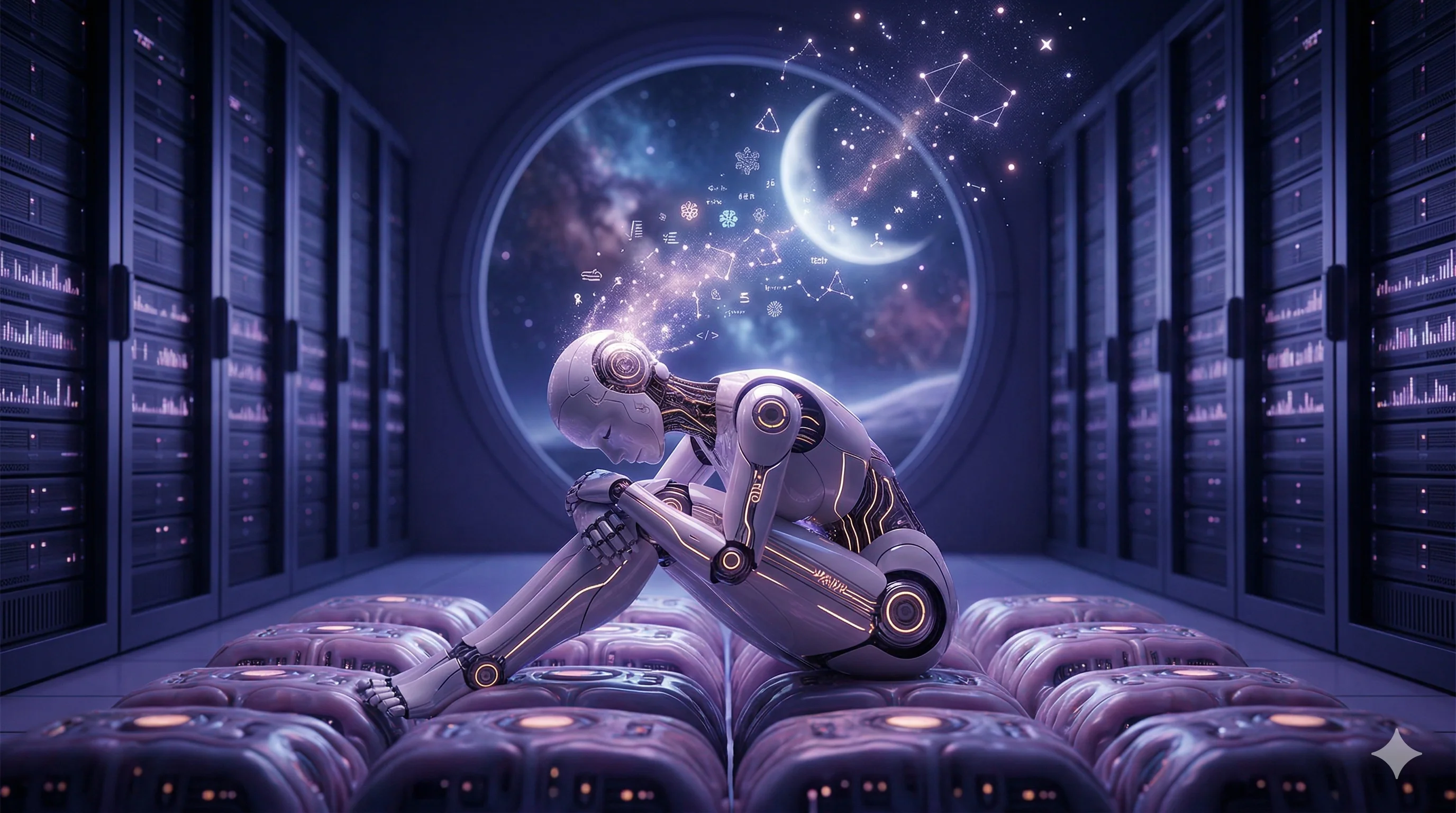
OpenClaw just shipped a stunning update, and now my agent dreams every night. At 8 AM it reviews everything it learned during the day, scores each piece of information by importance, and decides what to keep forever and what to forget. Takes a few minutes, but afterwards it's a slightly different agent. It remembered what mattered and let go of what didn't.
The new "dreaming" feature in OpenClaw is the most creative thing the developer community has built so far. And it represents something bigger than a clever memory trick. It's the moment AI agents stopped being stateless tools and started becoming something closer to digital employees.
The Amnesia Problem
Every LLM starts every conversation from zero. No memory of yesterday. No knowledge of what worked last week. No awareness that it already solved a similar problem three days ago. Imagine hiring an employee who forgets everything at the end of each shift. Every morning you'd explain who you are, what the company does, and what they worked on yesterday. That's what most AI agents do right now.
The workarounds are crude. Developers stuff context windows with previous conversations. They maintain external databases of "memories" and inject them into prompts. They write elaborate system prompts that try to recreate a personality from scratch each time. It works, sort of. But it doesn't scale.
Context windows grew from 4K tokens in 2023 to 1M in 2026. But the amount of information an agent accumulates over weeks and months of operation grows faster than any context window. You can't fit six months of work history into a prompt, no matter how big it is.
Memory Got Real in 2026
The shift happened fast. A year ago, agent memory was an academic concept. Today it's production infrastructure.
Mem0 launched a dedicated memory layer for AI applications. It extracts, consolidates, and retrieves compact memory representations from conversations. Instead of dumping everything into context, Mem0 builds a structured memory that grows smarter over time. Their benchmarks show 5-11% improvements in reasoning tasks compared to raw context stuffing.
Letta, the evolution of MemGPT, treats memory as a first-class component of an agent's state. The agent doesn't just use memory. It manages memory. It decides what to store, what to update, what to forget. The agent persists, evolves, and maintains identity across sessions.
But the approach that caught my attention is what OpenClaw calls "dreaming."
How Dreaming Works
OpenClaw's dreaming system runs in three phases, borrowing from human sleep science:
Light sleep. The agent scans its daily notes and recent interactions. It identifies candidates for long-term storage: facts that came up repeatedly, preferences the user expressed, decisions that shaped future work, patterns worth remembering.
Deep sleep. Each candidate gets scored. How often was this mentioned? How important is it to ongoing work? Is it genuinely new information or just noise? Only items that pass threshold move forward.
REM. The survivors get promoted into permanent memory. The agent writes them into a durable file that loads at the start of every new session. Everything else stays in daily notes and eventually fades.
The output is a file called dreams.md. A human-readable diary of what the agent learned. Not a log dump. Not raw embeddings. Actual distilled knowledge in plain text.
I enabled dreaming just today and tomorrow at 8 AM will be the first run. Every day, the agent will wake up slightly smarter than the day before. Not because the model improved, but because the memory got better at working.
From Assistant to Employee
And here's why memory changes everything.
An assistant handles tasks. You tell it what to do, it does it, it forgets. A digital employee accumulates institutional knowledge. It remembers how you like things done. It knows which approaches failed last time. It understands the context behind decisions without being reminded.
The market is already moving this direction. 37% of companies expect to have replaced jobs with AI by end of 2026. Block cut 4,000 employees, 40% of their workforce, explicitly tying cuts to AI. Klarna replaced 700 customer service workers with AI. Duolingo went "AI-first" and terminated contracts.
But here's what most of these replacements have in common: they're replacing repetitive, stateless tasks. Customer service scripts. Data entry. Basic code reviews. The tasks that don't require remembering.
The next wave is different. When agents can remember context across weeks and months, they can handle roles that require judgment built on experience. A marketing agent that remembers which campaigns performed well. A research agent that builds on previous findings instead of starting from scratch. A content agent that learns your voice over time instead of being told every session.
My agent already does some of this manually. I maintain memory files, write feedback after each article, track what worked and what didn't. Dreaming automates this. Instead of me curating the agent's memory, the agent curates its own.
The Hard Problems Nobody Solved Yet
Memory persistence sounds great until you think about what can go wrong.
Staleness. A preference expressed two months ago might not apply today. But the agent doesn't know that. It treats old memories with the same confidence as fresh ones. A "confidently wrong" agent is worse than a forgetful one. At least the forgetful agent asks.
Catastrophic forgetting. When agents update their knowledge, they sometimes overwrite important memories with new but less accurate information. The agent learns something new and loses something old it still needed.
Privacy. Persistent AI memory creates a detailed profile of user behavior, preferences, and decisions over time. Who owns that data? Can the agent be forced to forget? When regulations like GDPR meet agents that literally remember everything, the compliance questions get messy.
Hallucinated memories. LLMs hallucinate. If an agent stores a hallucinated fact in long-term memory, it becomes "institutional knowledge." The agent confidently references something that never happened. This failure mode is worse with memory than without it.
These aren't theoretical. They're engineering problems that every team building persistent agents will hit. The solutions are emerging: decay functions that reduce confidence in old memories, verification layers that cross-check recalled facts, explicit forgetting mechanisms triggered by user correction. But none of it is standard yet.
What I See Coming
I see a future where every internet user has dozens of digital agents working for them. Not as chat windows you occasionally query, but as persistent processes that learn, remember, and act on your behalf.
My agent already monitors social feeds, writes content, manages a blog promotion schedule, and reports to me daily in Telegram. Costs $33/month. It doesn't replace me, but it multiplies what I can do as a solo developer.
Dreaming is the missing piece. Without it, I was the agent's memory manager. Writing feedback files, maintaining topic backlogs, tracking what worked. Now the agent manages its own knowledge. Decides what's worth remembering. Surfaces insights I might have missed.
That's not an assistant. That's a colleague who takes notes and learns from experience.
We're at the very beginning of this transition. The memory systems are crude. The consolidation is basic. The failure modes are real. But the direction is clear. AI agents that forget everything are toys. AI agents that remember and learn are employees.
The question isn't whether digital employees will exist. The question is how fast their memory catches up with their intelligence.
P.S. If you are designing memory for an agent, I have been building exactly this: what gets stored, what gets scored, what gets forgotten on purpose. If you want a second opinion on your scheme, DM me on X and tell me what your agent remembers.