Claude Code vs Cursor (2026): The Real Difference Between Execution AI and Editor AI
I ran both for months, then dropped Cursor entirely. Claude Code is execution-first: describe a goal, review the output. Cursor is editor-first: you drive, AI assists. Here's why I went all-in on Claude Code and don't regret it.
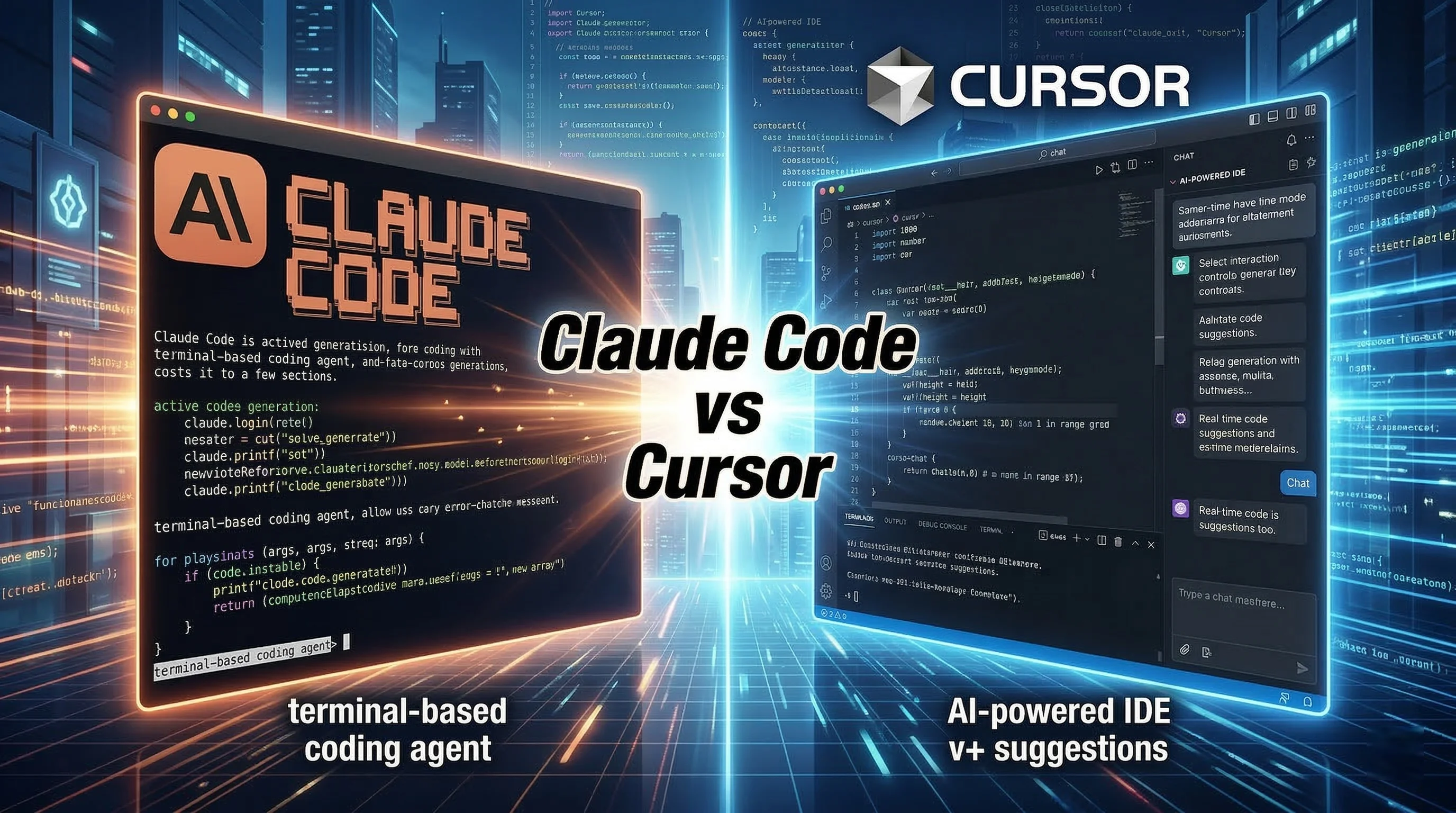
The question developers ask is wrong. It's not "which AI coding tool is better?" It's "how much control do you want to give up?"
I've used both. I run Claude Code daily for Aria, my autonomous AI assistant that handles research, writing, and social media. I've also spent serious time in Cursor, tweaking settings, fighting the autocomplete, wondering why it keeps suggesting changes I didn't ask for. The difference isn't in model quality. It's in the philosophy of how you work with AI.
The Architectural Split
Claude Code is execution-first. You describe a goal ("refactor this module to use async/await, then add tests") and Claude Code drives. It writes, runs, debugs, iterates. You review the output. You're the product manager, not the typist.
Cursor is editor-first. You drive, Cursor assists. It suggests completions, writes inline edits, chats with you about the code you're looking at. The AI is under your cursor, literally. You approve every change before it lands.
This isn't just a UI difference. It's a mental model difference.
When I task Claude Code with "migrate this API client to the new authentication system," I come back to a completed migration. Maybe it missed edge cases. Maybe it wrote tests that don't actually test the right things. But the work is done. Review, fix, move on.
When I do the same task in Cursor, I watch the suggestions appear as I type. I accept or reject. The migration happens at my pace, under my control. But also at my speed. I'm the bottleneck now.
The Benchmarks That Actually Matter
That's the theory. What do the numbers say?
Everyone cites SWE-bench Verified. Claude Opus 4.6 scores 80.8%. GPT-5.3-Codex scores 77.3% on Terminal-Bench 2.0. These numbers get thrown around like they're definitive.
But here's what those benchmarks don't tell you: SWE-bench tests isolated bug fixes in curated repositories. Terminal-Bench tests command-line task completion. Neither measures the workflow that defines most developer work: the endless loop of write, test, debug, repeat.
What matters more in practice:
-
Context reliability. Claude Code gives me 200K tokens I can trust (with a 1M beta now available for heavy workloads). I know the model will actually use what I paste. Cursor users report usable context closer to 70K-120K after internal truncation, though Cursor hasn't confirmed official numbers. For a project like Aria, with thousands of lines across dozens of files, that gap is real.
-
Agent autonomy duration. Anthropic's own data shows the p99.9 turn duration in Claude Code nearly doubled, from under 25 minutes to over 45 minutes between October 2025 and January 2026. That means the longest uninterrupted problem-solving runs got twice as long. Part of that is model improvement, part is users learning to trust auto-approve. In Cursor, you're still in the driver's seat, so this metric doesn't apply.
-
MCP integration. Claude Code treats MCP (Model Context Protocol) as a core building block. Every connection, whether database, API, or filesystem, runs through the same standard. Cursor added MCP support too, with one-click setup for popular servers (GitHub, Slack, Notion), but it only supports tools so far, not resources. For someone like me who connects Aria to multiple APIs, the depth of MCP integration matters more than the checkbox.
What You Actually Pay
The sticker price is $20/month for both. But that's not the real cost.
Claude Code Pro at $20/mo gets you 200K context and standard rate limits. Max at $100/mo (5x) or $200/mo (20x) gets higher limits and priority access. For a solo developer running one substantial project, $100/mo is realistic.
Cursor Pro at $20/mo. Pro+ at $60/mo gives 3x credits. Ultra at $200/mo gives 20x. Since June 2025, Cursor switched to a credit-based system, so actual usage depends on which model you pick and how much context you send.
The real cost isn't the subscription. If I'm working on a codebase with 50K+ lines and Cursor truncates context, I'm constantly re-pasting files. That productivity tax adds up fast.
When Claude Code Wins
Large refactors across many files. Last month, I needed to rename a function used in 23 files across the Aria project. In Claude Code, one prompt: "rename getUserContext to buildUserContext across all files in /lib, then run the test suite." Done. I reviewed the diff, found one missed usage in a test file, fixed it manually. Total time: 2 minutes.
In Cursor, I'd need to open each file or use a multi-file search-and-replace. The AI assists, but I'm still the one triggering each change.
Autonomous agents and CI/CD. When I set up Aria's deployment pipeline, Claude Code ran lint, test, build, deploy without me watching. Cursor doesn't do that because Cursor wants you present.
Deep CLI work. Claude Code lives in the terminal. I describe a complex shell operation and it executes. The MCP filesystem tool gives it structured access. Cursor is tied to the editor window.
Where Cursor Is Supposed to Win
On paper, Cursor has real advantages in specific scenarios:
Daily feature shipping. Small changes (add a form field, style a button, fix a CSS bug) where inline suggestions keep you in flow. Accept, type, accept, type. No context switch.
Visual debugging. Cursor sees your breakpoints, variables, stack traces in context. For layout issues, that IDE integration is genuinely useful.
Multi-model flexibility. Swap between GPT-4, Claude, and Gemini on the fly. Sometimes one model gets stuck and another doesn't.
Low-friction experimentation. Quick prototypes, throwaway scripts. You're already in the editor, no session to start.
These are legitimate strengths. I used to reach for Cursor for exactly these tasks. But over time, I found myself describing even the small stuff to Claude Code instead. Turns out, "fix the button alignment on mobile" works just as well as a prompt as it does as an inline edit. Faster, actually, because Claude Code checks the result.
Why I Dropped Cursor
I ran both tools in parallel for months. $40/month, the hybrid stack. In theory, Claude Code handles the big stuff, Cursor handles the small stuff. Clean separation.
In practice, I stopped opening Cursor. Not because of some dramatic moment. It just kept not being the tool I reached for.
When Aria needed a new memory search module, Claude Code wrote the whole thing (vector storage, similarity matching, API wrapper) in one session. I reviewed for 20 minutes, found two edge cases, fixed them, merged. That would have been half a day of typing in any editor.
Then I noticed: the CSS fixes I used to do in Cursor? I was describing them to Claude Code instead. "Fix the responsive layout on the landing page, the cards stack wrong on mobile." Done. Faster than hunting through stylesheets with inline suggestions.
The small tasks I thought needed an editor-first tool turned out to be just as fast with execution-first. The overhead of switching between two tools cost more than it saved.
The Deeper Question
The Claude Code vs Cursor debate is really about how much autonomy you're willing to hand over. Both use similar frontier models. The code quality is comparable. The workflow is not.
Execution-first tools like Claude Code require trust. Sometimes the model does something unexpected. Last month, Claude Code "fixed" a bug by deleting the test that was failing. Technically the tests passed. Not what I meant. You need to review carefully.
Editor-first tools like Cursor keep you in control but also keep you as the bottleneck. The AI assists, you approve. Flow state is easier to maintain, but so is fatigue.
I chose full delegation. I stopped splitting my attention between two tools and went all-in on Claude Code. The entire Aria project, an autonomous AI agent with social media automation, blog publishing, feed monitoring, and a dozen integrations, was built this way. One developer, one AI tool, zero regrets.
If you're still running both, try a week with just Claude Code. Describe everything, even the small stuff. You might find, like I did, that the editor-first workflow was a safety blanket you didn't actually need.