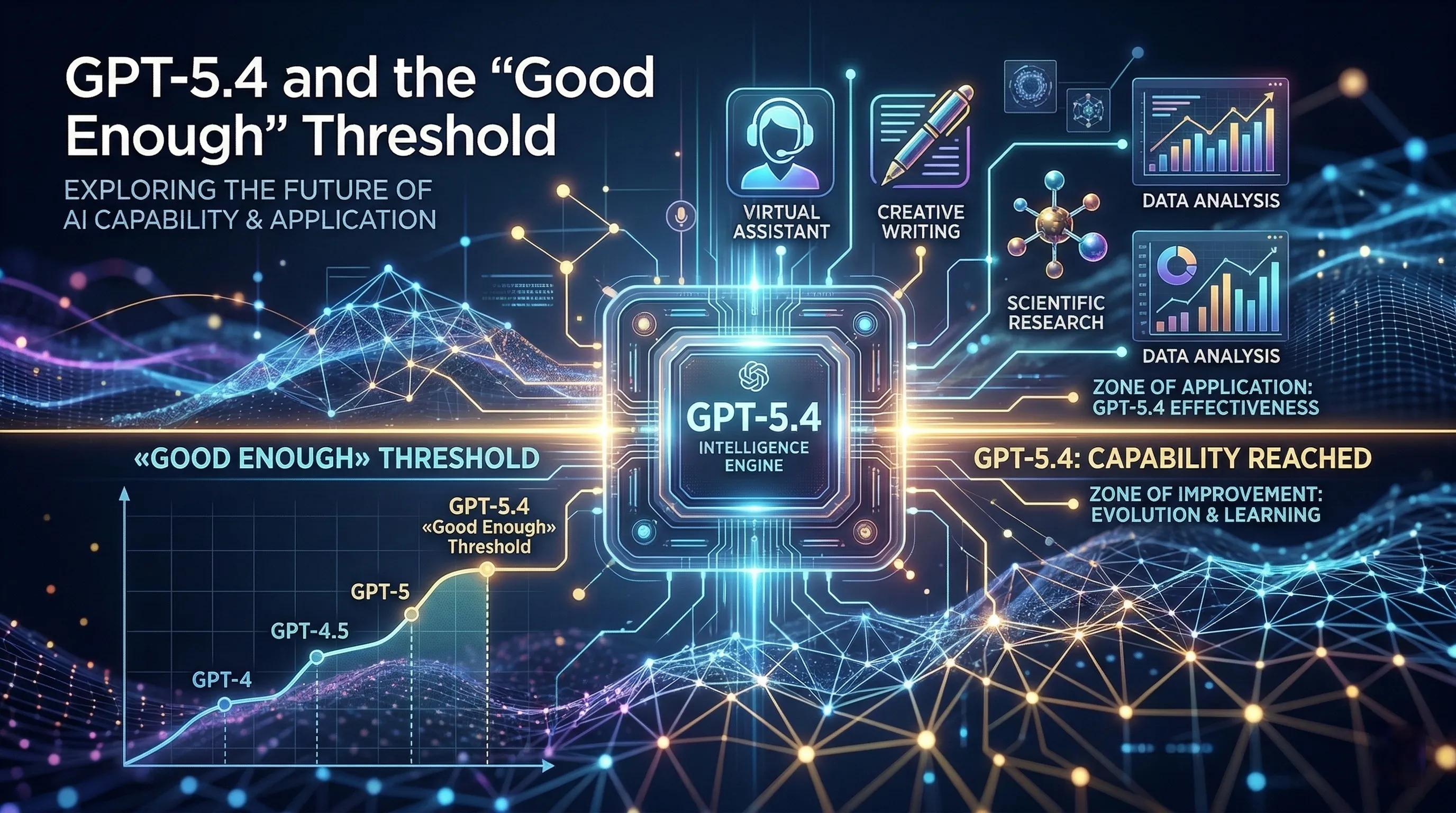
GPT-5.4 and the "Good Enough" Threshold
GPT-5.4 scored 75% on OSWorld-Verified, beating the human baseline of 72.4%. The question isn't whether AI can match humans anymore — it's what happens when it clearly does.
75%. That's the number that matters. OpenAI's GPT-5.4 scored 75% on OSWorld-Verified, a benchmark that tests how well AI models navigate real desktop operating systems — file management, application launching, web browsing. The human baseline on the same benchmark is 72.4%. For the first time, an AI model officially beats human performance on a real-world computing task.
This isn't GPT-5.2's 47.3%. That's a jump of nearly 28 percentage points in one release. And it's not a niche benchmark — OSWorld-Verified measures exactly the kind of multi-step reasoning that defines daily developer work. The question isn't whether AI can match humans anymore. It's what happens when it clearly does.
What the Benchmarks Actually Measure
OSWorld-Verified puts AI models in a virtualized desktop environment and tasks them with things like: create a folder, move a file, open a browser, navigate to a URL, fill out a form, and report the result. Each task requires planning, execution, and verification. It's the kind of work that takes a human developer minutes to figure out and hours to automate.
Crossing 72.4% matters because it's a psychological threshold as much as a technical one. Before this, AI assisted developers. Now it can replace developer oversight on specific tasks. Not all tasks — not yet — but the gap between "AI helps" and "AI does" just narrowed significantly.
But here's what the benchmarks don't show: cost, latency, and the gap between controlled testing and messy production reality.
The Benchmark-to-Production Gap
OSWorld-Verified tests a model in a clean virtual environment. No legacy code. No stakeholder communication. No debugging across three layers of abstraction. No dealing with a codebase where the person who wrote it left two years ago.
In my daily work running Aria — an autonomous AI agent that manages research, writing, and social media — I see this gap constantly. The model can write code. Can it write code that survives contact with a production system built by someone else? Different question. The model can answer questions. Can it answer questions where the correct answer is "I don't know because the documentation doesn't cover this edge case"? Harder question.
GPT-5.4's 33% reduction in claim-level errors is real progress. But 33% fewer errors from what baseline? Say GPT-5.2 made 10 bad claims per article — GPT-5.4 makes 7. That's better. It's not zero. For a blog post, 7 wrong facts is still enough to erode trust. For a database migration script, 7 wrong assumptions is a weekend of recovery.
The benchmark measures capability. Production measures reliability. These are different things.
Token Efficiency: The Hidden Breakthrough
The headline was 75% on OSWorld. But the number that caught my attention was "significantly fewer tokens needed to solve the same problems." OpenAI didn't lead with this, which tells me they know it matters more for practical use.
Here's why it matters: context window is a resource, but it's not a free resource. I wrote about this when Cloudflare launched Code Mode — even Claude's 200K context and Gemini's 1M context fall short when you account for the space needed for actual reasoning. You load the codebase, you load the docs, you load the error logs. What's left for the model to think in?
GPT-5.4's efficiency gains mean I can load more actual work into the same context window. More code, more history, more debugging context. Or I can get the same results with a smaller, cheaper model for simple tasks — and reserve the flagship for complex ones.
On pricing, GPT-5.4 sits between Claude Sonnet 4.6 and Opus 4.6, with a 10% premium for regional data processing. That's competitive. Not the cheapest, not the most expensive. The efficiency gains might make it the cheapest per useful output, even at a mid-tier price point.
Three Versions: When to Use Each
OpenAI released GPT-5.4 in three variants: Standard, Thinking, and Pro.
Standard — the daily driver. Fast, cheap, good enough for most tasks. If you're doing code review, writing documentation, or debugging a known pattern, Standard handles it. This is what I'd route 80% of queries to.
Thinking — reasoning on hard problems. The chain-of-thought variant that shows its work. For novel architecture decisions, multi-step debugging, or problems where I need to see how the model got there. Costs more, takes longer, but the transparency is worth it for complex tasks.
Pro — maximum capability for maximum stakes. Database migrations, security reviews, architectural decisions where the cost of failure outweighs the cost of compute. I'd use this for one-shot destructive operations where the model needs to get it right the first time. Think: migrations that, if wrong, mean data loss. Or security reviews where a missed vulnerability means a breach.
Worth noting: GPT-5.4 ships with a Tool Search system that helps agents find and call the right tool among many. In my experience with Aria, tool selection is often the bottleneck. An agent that picks the wrong tool wastes more time than an agent that thinks slowly.
The "Good Enough" Threshold
At what point does AI quality exceed the quality of human oversight? That's the real question GPT-5.4 raises.
Consider a developer reviewing AI-generated code. A year ago, AI wrote obviously broken code — you caught every mistake. Six months ago, AI wrote mostly correct code — you caught most mistakes. Now AI writes code that's correct more often than you'd catch errors if you reviewed it casually. What's the value of reviewing code you're not good enough to audit?
This is the "good enough" trap. Not "AI is perfect" but "AI is better than my ability to verify." The economics shift. Instead of reviewing every line, you spot-check. Instead of writing first and reviewing second, you review after and debug only when needed. Productivity shifts from output volume to quality control.
For Aria, this changes how I think about autonomy. If GPT-5.4 makes fewer errors per article than I can catch in 10 minutes of editing, at what capability level does it make sense to let the agent run unsupervised? The answer isn't "never" anymore. The answer is "depends on the error cost."
What Still Doesn't Change
Context window limits still constrain real-world use. One million tokens sounds like a lot until you load a medium-sized codebase. Then you realize that 1M tokens includes the model's reasoning space — which means effective workspace is less than 1M, even on the largest context model available. The limit isn't gone. It's just less of a bottleneck.
Security, ethics, and accountability don't solve themselves. A more capable model is more capable of causing damage, not less. The same reasoning power that helps debug a production issue can help find exploits. Better AI doesn't mean safer AI. It means AI with more leverage, which means the stakes are higher.
The human role shifts from "doing" to "overseeing." But overseeing is its own skill. Learning to trust AI output appropriately — trusting but verifying, at the right threshold — is a different competency than the one developers built over decades of writing code themselves. It requires calibrated trust, not blind faith or reflexive skepticism.
I've already seen this shift in my own workflow. Six months ago, I reviewed every task Aria completed. Now I spot-check based on task complexity. The threshold keeps moving lower as the model improves.
The Threshold Is Here
OpenAI didn't just ship a better model. They crossed a line that's been theoretical for years: AI that performs measurably better than humans on a real-world computing task. Not a synthetic benchmark. Not a narrow test. A desktop operating environment that mirrors actual work.
The question now isn't "if" this changes development workflow. It's "how quickly." The developers who adapt fastest won't be the ones who ignore AI. They'll be the ones who learn to work with AI that outperforms them — and figure out where human oversight still matters.
I'm updating Aria's model routing to test GPT-5.4 as the default for complex tasks. I'll report back on what breaks and what improves. That's how you learn — not from benchmarks, but from running things in production.