A Prosthetic for Willpower
Every site limiter has the same flaw: you can switch it off with one click, so the protection is willpower, and willpower runs out exactly when you need it. I built Curfew, a browser extension where relaxing a rule costs a solved puzzle, and this is what it taught me about friction and harnesses.

I never knew how much time I was spending in the X feed, and it bothered me. My phone has decent screen-time tools that cover any app. Desktop is a different world: you assemble your own setup out of spare parts, and it works worse.
Not that I hadn't tried the extensions that do this. Every one of them had the same flaw: the block is easy to walk around. The effort to bypass it is smaller than the laziness buffer. It's so easy that laziness doesn't even get a chance to say "come on, forget it." On the phone the bar is low too, but there you can go the extra mile and set up parental controls, or install a third-party app that adds more friction.
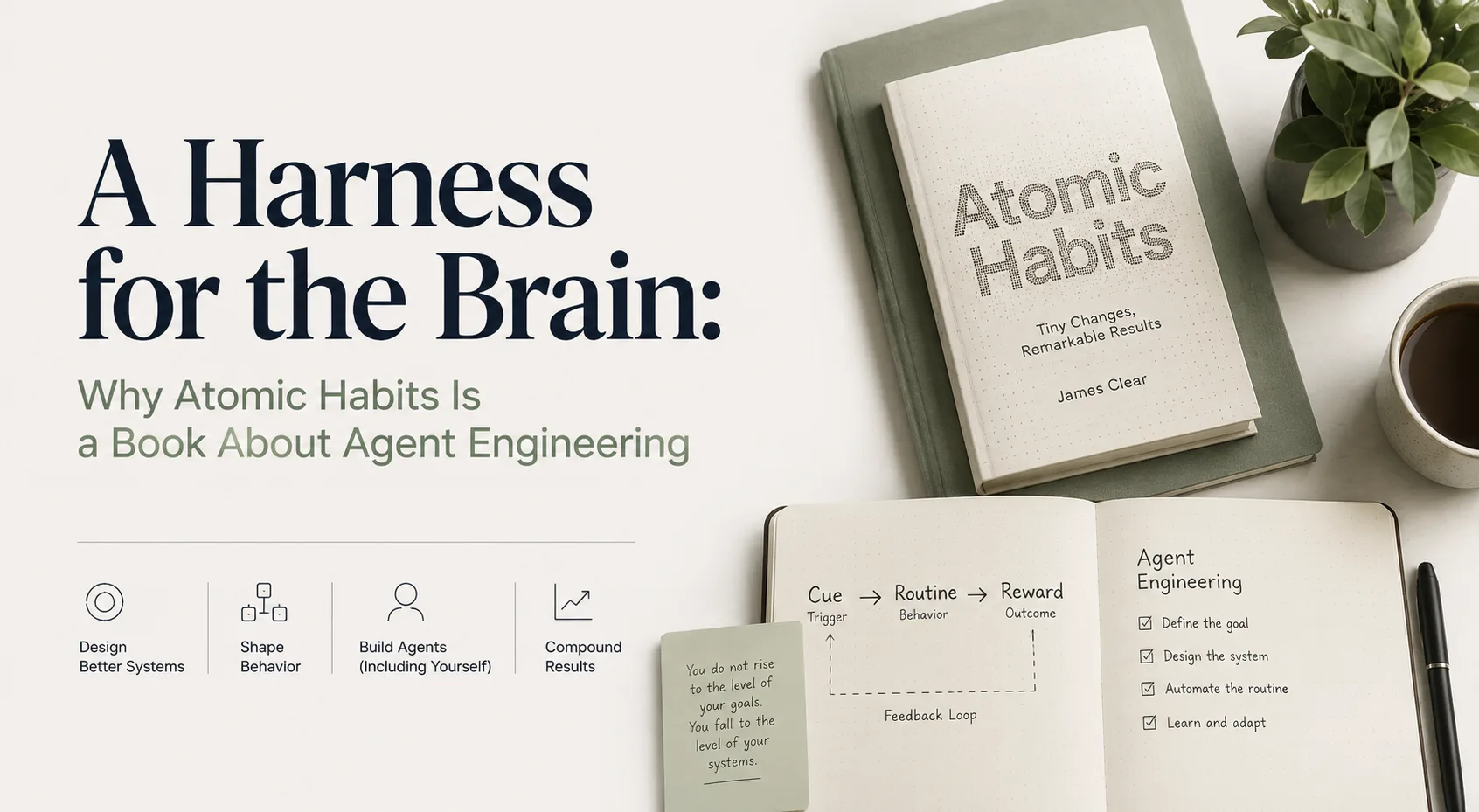
On desktop it's harder. But while I was writing the article about harnesses, I thought: I want the same structural approach for myself. Not rules I agreed to follow, but a path to breaking them that is simply closed. In that article I went through Atomic Habits and how it builds good habits. It covers the bad ones too, and even the simplest method works: put it out of sight. And the most useful tool in all of it is our own laziness.
So I applied those methods and built myself a small harness to control doomscrolling, one that is usually too much trouble to get around.
That software is Curfew, a browser extension that tracks and limits daily budgets for the sites you choose.
Willpower is not a plan
There is no shortage of extensions that limit time on sites. Every one of them can be switched off easily: give yourself ten more minutes, then ten more, then drop the limit entirely. The whole thing rests on willpower. But willpower is stored energy: sometimes there is plenty, sometimes almost none. The trick fails exactly when you are deep in the feed, want one more thing, and promise yourself you will turn it off afterwards.
A budget I can remove with one click is a budget I will remove, and then I will feel bad about my lack of discipline. Double damage.
Why not block the whole site
Yes, you can put sites into hosts and block them for good. For a certain category of sites it works perfectly. For sites that are useful in doses it is too blunt. You do need social networks, and a daily limit is the better tool there. The problem was never the site, it was the endless scroll.
My app is called Curfew for a reason, and the metaphor is literal. It is not a ban on going outside forever, it is a statement of when. You spend the budget, and past it you lose access, and over time you learn to spend it well. Two things in one: a report and a limit. The best harness for the brain.
How laziness helps
The point is not the budgets, though. It is what makes them binding.
Loosening a rule, turning a budget off, removing a site from the list, or importing a config with softer rules cannot be done with one click. You solve a puzzle first. I built two kinds. The first is a long arithmetic equation, good for mental math practice. For those whose hand may reach for the calculator on the desk, there is a second option: the classic 15-puzzle.
So the part of me that wants the feed has to do arithmetic or slide tiles first. In practice the brain is too lazy, and it is at its laziest exactly when willpower is running out. The lock works precisely when it is needed.
And control stays with me. This is not a prison. When something genuinely needs to change, there will be enough motivation to solve the puzzle. The fact that I solved it is the whole point: the decision became deliberate instead of automatic. Adding sites and tightening the block is free and unpunished. Loosening requires passing an exam. The flywheel only turns one way.
The pair I described in the Atomic Habits article works here too: guides lead up to the action, sensors look at the result afterwards. The arithmetic is a guide: it stands before the action. The pass counter is a sensor: it shows the result without effort, not "I think I'm doing better" but a specific number for today. Without a sensor the decision stays invisible, and an invisible decision cannot be corrected.
A prosthetic, not character
For myself, I call these tools prosthetics for willpower.
A prosthetic does not make anyone disciplined. It puts a small piece of structure exactly where discipline ends, and raises the price of breaking the rule. Exactly what Atomic Habits says.
And it is also what I learned about agents. A linter test does not ask an agent to keep the style. It does not let the commit through. A tool schema does not remind about a required field. It rejects the call. Same thing here: not "try to spend less time in the feed" but a concrete obstacle at a concrete point.
Where I won't overstate
The extension can be switched off, like any other in Chrome. That is not a bug or an oversight, it is a decision. The goal was not to build something that cannot be bypassed, it was friction between the impulse and the action.
It covers only the sites you add to it. And it does not pretend to raise your productivity through saved hours and improved focus. It is a small hack for the brain, nothing more.
I deliberately skipped the fashionable features, streaks and records. They turn into a metric for the sake of a metric, which replaces the goal. You can watch it happen in Duolingo, where learning a language turns into keeping a streak alive. It would also make the app more complex, and I wanted to keep it as simple as possible. And no features that would compromise privacy.
If you have the same problem, you can look at the app here. Extension: Chrome Web Store. Source: devacc8/curfew-extension under MIT.
Instead of an ending
A harness is the thing that helps us do what we do not really want to do. Look at our lives through that lens and a lot of things read differently. A personal trainer at the gym is not only someone who writes the plan and fixes your form. They are also an external source of willpower, an obligation that stops you from skipping sessions. An office, compared to working from home, puts you in a working mood and turns off the internal dialogue.
So we have been using harnesses for a long time. New approaches just add more ways to build habits and routines.
P.S. Working on something in AI or crypto and want a second opinion? DM me on X.